
Natural Stone vs Porcelain Slabs: Pros and Cons
Compare natural stone and large-format porcelain slabs for countertops and walls: appearance, durability, fabrication, edges, cost and authenticity.
The short answer
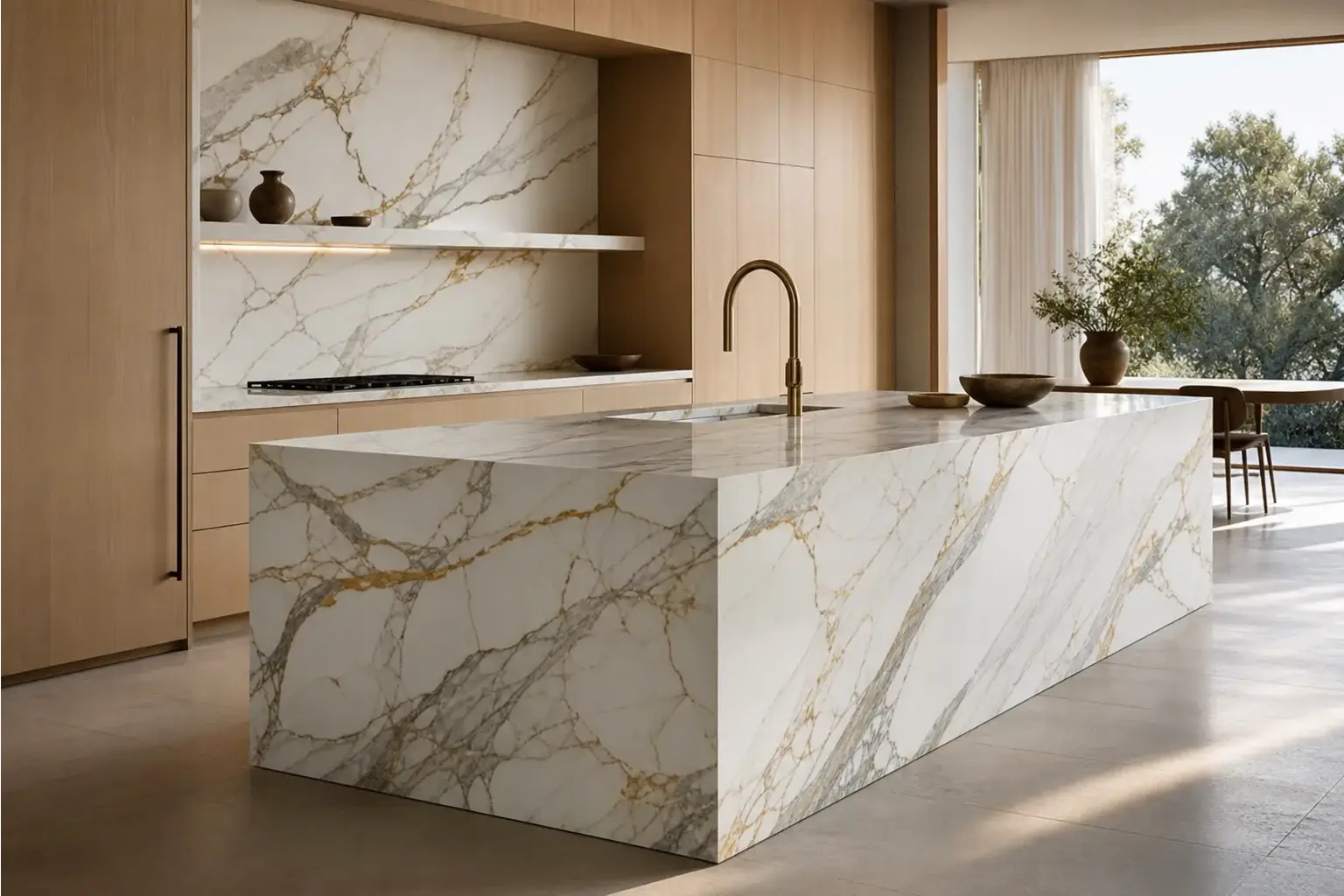
Large-format porcelain slabs are thin, hard, non-porous and can mimic marble, but their pattern is printed on the surface and edges may not show the same through-body look as stone. Natural stone offers authentic depth, unique veining and thicker profiles, and can be repaired by honing and polishing. Porcelain suits walls, outdoor areas and modern designs; natural stone suits those who value authenticity.
Key takeaways
- Porcelain mimics stone with printed patterns.
- Natural stone has through-body color and depth.
- Porcelain is non-porous and UV stable.
- Fabrication of thin porcelain requires specialized skills.
What porcelain slabs are
Large-format porcelain slabs are made from clay and minerals pressed and fired at high temperatures. Patterns, including marble looks, are applied digitally. They are often thinner than stone slabs.
Comparison
| Factor | Natural stone | Porcelain slab |
|---|---|---|
| Pattern | Natural, through-body | Printed surface, some through-body options |
| Thickness | Commonly 2cm or 3cm | Often thinner |
| Porosity | Varies by stone | Very low |
| UV stability | Many stones good | Very good |
| Edge profiles | Wide range | Limited; often mitered |
| Repairs | Can hone and polish | Chips are hard to repair |
| Fabrication | Common | Specialized |
Appearance
Porcelain can look convincingly like marble from a distance. Up close, depth and edges reveal the difference. Mitered edges are often used to hide the cross-section.
Durability
Porcelain resists scratches, stains and heat well, but thin slabs can chip at edges and are brittle during installation.
Applications
- Porcelain: wall cladding, outdoor kitchens, furniture, modern kitchens.
- Natural stone: kitchens, bathrooms, feature walls, projects valuing authenticity.
Silica
Porcelain slabs typically contain less crystalline silica than many engineered quartz products, but cutting any of these materials produces dust that should be controlled. See OSHA silica rule.
Fabrication and installation differences
Thin porcelain slabs require specialized blades, careful handling and support during transport and installation. Not every fabricator works with porcelain, and those who do may charge differently. Natural stone fabrication is more widely available.
Edge details
Natural stone allows many edge profiles, from eased to ogee. Porcelain often uses mitered edges to hide the thin cross-section and printed surface.
Repairs
Natural stone chips can be filled and polished, and surfaces can be honed and repolished. Porcelain chips are more difficult to repair invisibly.
Outdoor use
Porcelain's low porosity and UV stability make it attractive for outdoor kitchens. Many natural stones, especially granites and quartzites, also perform well outdoors.
Look up close
Viewed from a distance, porcelain can mimic marble convincingly. Up close, natural stone shows depth, crystal structure and vein continuity through the edge. Compare both in person.
Making the choice
Choose porcelain if you want a uniform, low-maintenance surface in a modern design. Choose natural stone if authenticity, depth and repairability matter.
Frequently asked questions
Is porcelain better than marble?
Porcelain resists etching and staining better, but marble offers authentic depth and can be refinished. It depends on priorities.
Can porcelain slabs be used outdoors?
Many porcelain products are designed for outdoor use because they are UV stable and low porosity.
Why do porcelain countertops use mitered edges?
To hide the thin cross-section where the printed pattern may not continue through the body.