
What Is Marble? Formation, Minerals and Types Explained
What marble is made of, how it forms from limestone, why it has veins, how geologists and the stone trade define it, and how it behaves as a countertop.
The short answer
Marble is a metamorphic rock formed when limestone or dolostone is recrystallized by heat and pressure deep underground. It is made mostly of calcite or dolomite, has a Mohs hardness of about 3 to 4, takes a high polish and shows veins created by mineral impurities. Because it is a carbonate rock, marble reacts with acids, which causes etching.
Key takeaways
- Marble is recrystallized limestone or dolostone.
- Calcite and dolomite are its main minerals.
- Veins come from impurities and ancient fractures.
- The stone trade uses 'marble' more loosely than geologists do.
From seabed to slab
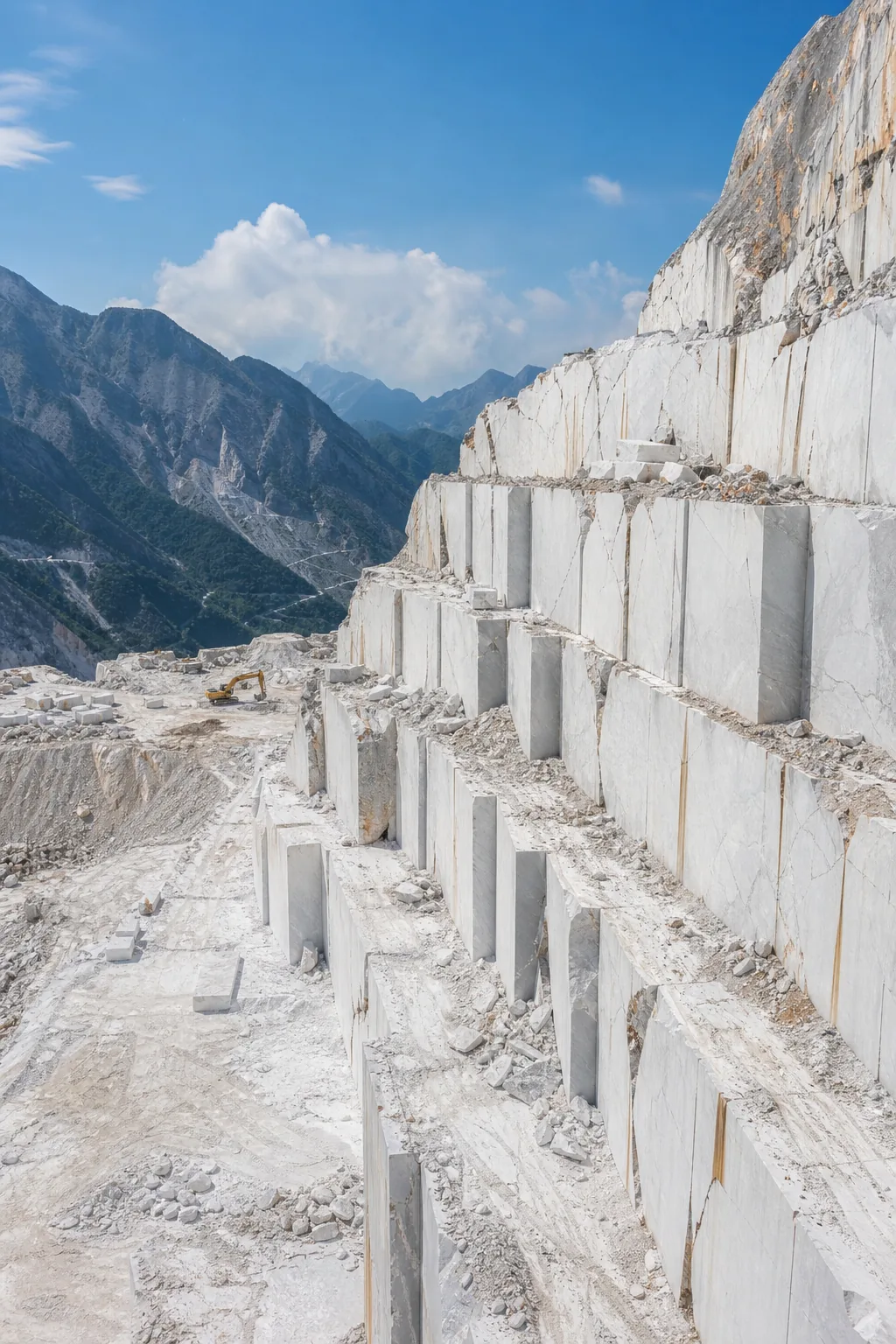
Most marble began as limestone: layers of calcium carbonate from shells, coral and chemical precipitation on ancient seabeds. Over millions of years, tectonic forces buried and squeezed these layers. Heat and pressure caused the original grains to recrystallize into a dense mosaic of interlocking calcite or dolomite crystals. That transformation, called metamorphism, is what turns a dull, porous limestone into a stone that can be polished to a mirror finish.
If the original rock was dolostone, rich in the mineral dolomite, the result is dolomitic marble. Thassos marble from Greece is a well-known example. Read more in dolomite vs marble.
What marble is made of
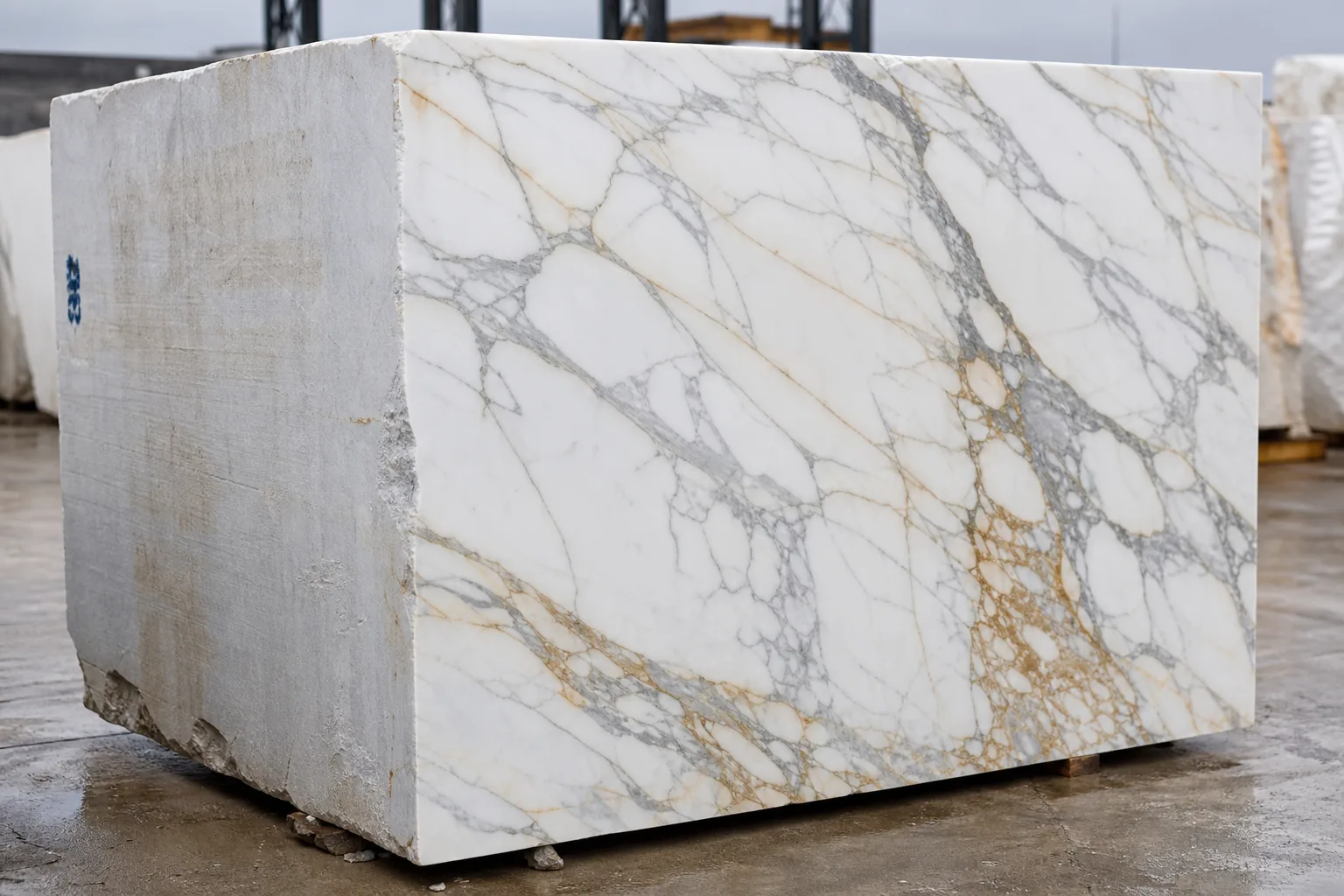
Pure marble would be snow white. Almost no marble is pure, and that is why it is interesting.
- Calcite (calcium carbonate) is the main mineral in most marble.
- Dolomite (calcium magnesium carbonate) dominates dolomitic marbles.
- Impurities such as clay, silt, iron oxides, graphite and serpentine create gray, gold, green, pink or black tones.
During metamorphism, impurities migrate and concentrate along planes and fractures. The result is the veining that makes Calacatta, Carrara or Arabescato instantly recognizable. Our guide to how marble veining forms goes deeper.
Geology vs the stone trade
A geologist calls a rock marble only if it is a metamorphosed carbonate. The stone trade is more relaxed: any carbonate stone that takes a polish is often sold as marble. That is why some dense limestones, such as Nero Marquina, and many colored "marbles" are commercially called marble even when their geology is debated. It is also why serpentine-rich green stones are sold as green marble. See stone trade names explained.
Physical properties that matter at home
| Property | What it means for use |
|---|---|
| Mohs hardness about 3 to 4 | Can be scratched by steel and grit |
| Carbonate chemistry | Etches with lemon, vinegar, wine and acidic cleaners |
| Low to moderate absorption | Can stain if spills sit; sealing helps |
| Good heat tolerance | Handles warm pans better than resin-based surfaces |
| Translucency | Thin or white marbles glow slightly in light |
These properties explain the classic marble trade-off: unmatched beauty with a surface that changes over time. Read why marble etches for the chemistry.
Major families of marble
- White marbles: Carrara, Calacatta, Statuario, Thassos, Danby and Georgia marble.
- Gray marbles: Bardiglio and many veined grays.
- Black marbles: Nero Marquina, Port Laurent styles.
- Warm marbles: Crema Marfil, Emperador, Botticino.
- Colored and exotic: Rosso Levanto, Calacatta Viola, Verde Guatemala.
Where marble comes from
Italy, Greece, Spain, Portugal, Turkey, India, China and the United States all produce marble. The U.S. has a proud history with Vermont, Georgia and Colorado marble used in national monuments; see marble in American monuments.
Why it still matters
Marble has been carved and polished for more than two thousand years, from Roman temples to Michelangelo's David to modern kitchen islands. No manufactured surface reproduces the depth of real recrystallized calcite, which is why demand for genuine marble slabs in the U.S. remains strong.
Keeping marble data with the slab
For distributors, the details above are not trivia: buyers ask about origin, mineral type, finish and care for every slab. iBlocky lets you store those notes, certificates and photos on each block, slab or bundle, so the answer goes out with the slab link.
Frequently asked questions
Is marble a rock or a mineral?
Marble is a rock made mostly of the minerals calcite or dolomite.
Is marble harder than granite?
No. Marble is about 3 to 4 on the Mohs scale, while the quartz and feldspar in granite are about 6 to 7.
Why is some marble white and some colored?
Pure calcite marble is white. Impurities such as iron oxides, graphite, clay and serpentine add gray, gold, pink, green or black colors.